


Most problems don’t fail at execution. They fail much earlier — when someone skips ahead without a real plan, or when results are never reviewed because the team moved on too fast.
The teams that consistently win aren’t always the most talented. They’re the most systematic. Here’s the framework I keep coming back to.
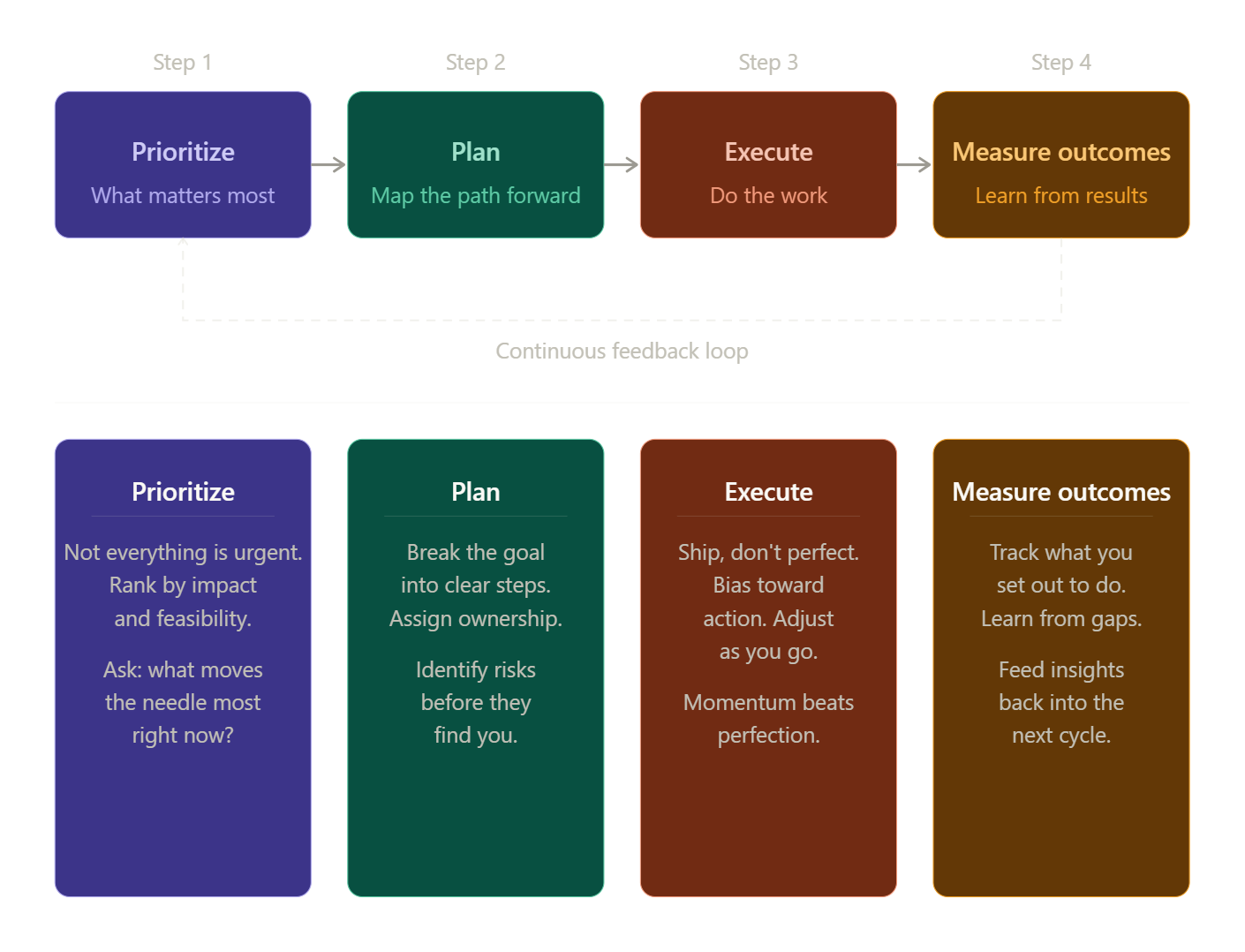
1. Prioritize — what actually matters right now
Every problem comes packaged with noise. The first move is to cut through it. Good prioritization is ruthless: if you could only work on one thing this week, what would move the needle most? The real skill is the honesty to deprioritize things you like in favor of things that matter.
2. Plan — map the path before you march
Once you know what to solve, get clear on how. A real plan names the steps, assigns ownership, and identifies the risks that could derail everything. It doesn’t need to be a 40-slide deck — it just needs to answer: what’s the sequence, who’s responsible, and what could go wrong?
3. Execute — momentum over perfection
The biggest trap here isn’t laziness — it’s over-engineering. Waiting for the perfect moment, the perfect version, the perfect conditions. They don’t come. Bias toward action. A done-at-80% solution that’s in the world teaches you far more than a perfect plan that never shipped.
4. Measure Outcomes — close the loop
Execution without measurement is just activity. Ask: did it work? What did we learn? What would we do differently? This is the most skipped step — and the most valuable. Done well, it doesn’t just evaluate the last project. It feeds the next one.
This isn’t a checklist — it’s a loop. Every time you measure outcomes, you get smarter about what to prioritize next. The teams that compound their results are just running this cycle, over and over, a little better each time.